Fruit Arcade Dash Challenge
Reviews
Fruit Arcade Dash Challenge keeps its scope tight: slice fruit, dodge boards, reach the finish. The 3D visuals and cheerful theme make it approachable for all ages, while the changing layouts give practiced players a reason to replay. Its hypercasual length means depth is limited, but the immediate feedback and gentle difficulty curve support steady improvement without frustration.
Description
Core Slicing Mechanic
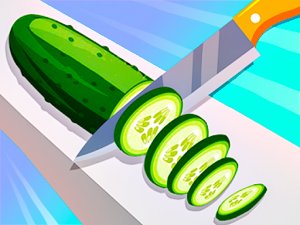
Fruit Arcade Dash Challenge centers on a single repeated action: holding and releasing the screen to perform a slicing motion. That motion connects with fruit in the path, and the goal is to interact with as many pieces as possible before reaching the finish line. Wooden boards share the same path, and hitting one causes a setback. The tension comes from reading when to slice and when to hold back, since the same input that collects fruit can also strike a board.
Course Layouts and Progression
Each level presents a new course with different fruit arrangements and board placements. Because the layout changes, success depends less on memorizing one sequence and more on recognizing patterns quickly. The game’s hypercasual structure keeps individual sessions short, so a failed attempt costs little time. That design encourages replaying a course to learn its rhythm and improve timing rather than grinding through long stages.
Controls and Feedback
The touch-based controls are intentionally simple: hold, release, slice. Immediate feedback after each attempt shows what went wrong, whether that was a mistimed slice or an unexpected board. This loop makes the game easy to pick up without a tutorial-heavy learning curve. Players who stay calm and act rhythmically tend to avoid the rushed inputs that lead to mistakes.
Visual Style and Audience
Bright 3D graphics and a cheerful fruit theme give the game a light, non-violent tone. There is no mature content, and the premise is straightforward enough for children and adults alike. The stress-free atmosphere suits quick breaks, and the gentle complexity curve means new players can start immediately while still finding room to sharpen their timing over repeated runs.






Editorial Notes